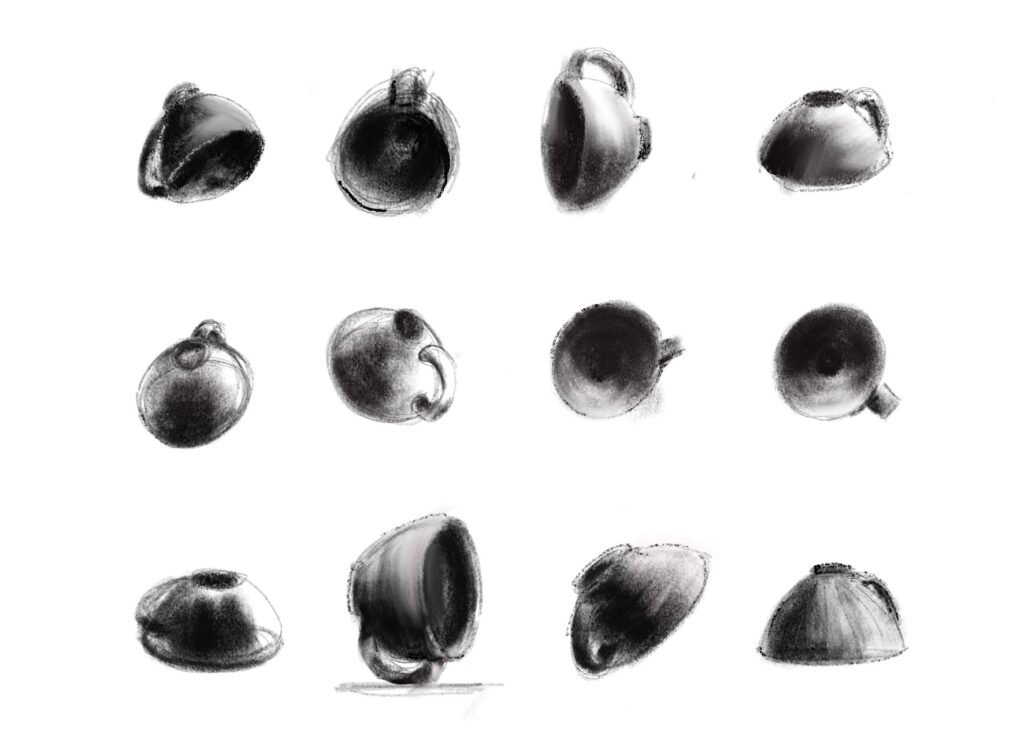
Most people try to improve their drawing by focusing on technique. But drawing doesn’t start with the hand. It starts with how you see. How you look at an object or living thing. Not looking with preconceived notions about it, but seeing it without judgment – that is what real drawing is about. And it’s the insidious thing that makes a drawing or sketch impossible to look away from.
If your drawings feel flat, inaccurate, or frustrating, it’s usually not a lack of talent — it’s a lack of observation.
This level is designed to train your ability to see clearly before you draw.
⸻
What you’ll learn
In this level, you’ll develop the foundational skill behind all drawing:
- How to observe shapes and forms accurately
- How perspective changes what you see
- Why drawing from memory leads to mistakes
- How to break out of symbolic drawing habits
This is the groundwork everything else builds on.
⸻
Why it matters
Most beginners draw what they think something looks like.
That’s why:
- cups become flat shapes
- proportions feel “off”
- drawings lack depth
Learning to see properly changes all of that.
Once your observation improves, your drawing improves naturally.
⸻
Start here – foundation articles
Begin with these short guides to understand the core ideas:
👉 How to Train Your Eye to See Like an Artist
👉 Why Your Drawings Look Flat (And How to Fix It)
👉 20 Simple Drawing Exercises Using a Coffee Cup
⸻
Do the core exercises – this is where it ‘clicks’
Understanding is one thing.
Training your eye is another.
👉 Start with the main exercise: 20 Views Drawing Exercise: Step-by-Step Tutorial
This is where you apply what you’ve learned in the articles to physical observation – using your hand and eye.
⸻
Then, use this interactive practice:
It’s a guided step-by-step practice session where you can apply what you’ve leanred above.
👉 Try the Practice Lab
It walks you through structured variations so you can focus on seeing — not guessing what to draw next.
⸻
How to approach Level 1:
Keep it simple:
- Work with real objects, not photos
- Don’t aim for perfect drawings
- Repeat the same object multiple times
- Focus on noticing changes, not results
This is training — not performance.
⸻
Common mistakes to avoid:
- Rushing through exercises
- Trying to make drawings look “good”
- Ignoring subtle changes in perspective
- Drawing from memory instead of observation
Progress comes from awareness, not perfection.
⸻
What comes next
Once you’re comfortable observing form and perspective, you’ll move into:
👉 Level 2: Light and Shadow
This is where your drawings begin to gain depth and dimension.
⸻
A final note
You don’t improve by drawing more things.
You improve by seeing one thing more clearly.
This is where that process begins.